
"coffee bean altitude"
30000 article(s) found

Why high altitude coffee is better Growing area Manor Flavor Description Taste characteristics Introduction
Coffee elevation turns out that scientific proof of this theory is not entirely trustworthy. There is some scientific evidence that the flavor of upland beans changes with altitude, but there is also some evidence that this is not true. Many people in the coffee industry, including myself, have demonstrated through their work experience that beans at different altitudes do respond differently when tested in cups. coffee

The altitude of coffee beans the difference between cocoa beans and coffee beans
The altitude of coffee beans the difference between cocoa beans and coffee beans simply put, the higher the altitude of coffee beans, the better the taste. Coffee beans grown at high elevations have pleasant acidity, rich aroma and rich taste, which everyone likes; on the contrary, coffee grown at low elevations has almost no sour taste, single taste and plain taste. That's why the coffee

Why should coffee beans be graded on the basis of altitude? what is the effect on coffee flavor?
Why grade coffee beans on the basis of elevation? First of all, we should realize that the influence of geographical location on the flavor of coffee beans is profound. All coffee grows in the tropics. In fact, altitude has no direct effect on coffee. However, altitude can affect the growth, development and quality of coffee through the redistribution of meteorological elements (temperature, light, heat, wind speed, rainfall, etc.).

Why the higher the altitude?-the better the flavor of the coffee.
Why the higher the altitude-the better the coffee flavor, the higher the altitude at which the coffee grows, will directly affect the size of the coffee beans.

What is the reason for the higher the altitude, the better the quality of coffee beans?
The reason why coffee beans are planted at higher altitude and better quality is that the coffee beans with the best quality are usually strong and grow at an altitude of more than 4500 meters. The growth of these coffee beans is very slow, so the density of the beans is very high, and the gap in the middle of the beans should be curved. In contrast, coffee beans grown at low elevations usually have a lower density and slightly open gaps in the middle.
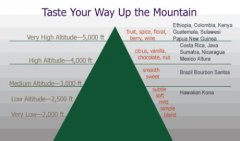
Effect of altitude on Coffee Flavor basic knowledge of Coffee
The influence of geographical location on the flavor of coffee beans is profound. All coffee grows in the tropics, and the altitude at which it grows has a profound effect on the taste of coffee. The tropical belt extends from 30 degrees north latitude to the equatorial regions of the southern mountains that produce the world's truly high-quality Arabica coffee. Central and South America, South Asia and some Pacific islands, south-central Africa is also the most important in the world.

Taste of Costa Rican Saint Roman Coffee in volcanic soil Grinding degree of manor in producing area
S.H.B. It is a very hard bean with an altitude of more than 1500 meters above sea level, which means high quality Costa Rican coffee. Altitude has always been a problem for coffee growers. The higher the altitude, the better the coffee beans, not only because the higher altitude can increase the acidity of the coffee beans and thus increase the flavor, but also because the night temperature at the higher altitude is lower, which can make the trees grow slowly.

A brief introduction to the High-quality Costa Rican Coffee Manor Tarasu Coffee Bean Goddess Manor
Excellent Costa Rican coffee is called extra hard beans, and this kind of coffee can grow at an altitude of more than 1500 meters. Altitude has always been a problem for coffee growers. The higher the altitude, the better the coffee beans, not only because the higher altitude can increase the acidity of the coffee beans and thus increase the flavor, but also because the night temperature at the higher altitude is lower, which can make the trees grow slowly.

What effect does the altitude of coffee beans have on the flavor?
Effect of altitude on coffee beans in addition, in areas with low temperature, the leaf shape of coffee trees is larger than that in areas with high temperature, and the photosynthetic effect of large leaves is stronger than that of small leaves. In high altitude areas, the leaves of coffee trees are large, dark green in color and thick in wax. Due to little change in temperature throughout the year, the chances of summer leaves becoming smaller are small, while the nutrients produced by strong leaves can.

Cultivation of fine coffee beans in Diamond Hill, Costa Rica, geographical location, climate, altitude
The higher the altitude, the better the coffee beans, not only because the higher altitude can increase the acidity of the coffee beans and thus increase the flavor, but also because the night temperature at the higher altitude is lower, which can make the trees grow slowly, thus the flavor of the coffee beans is stronger. In addition, due to the high altitude drop caused by sufficient rainfall, it is very beneficial to the growth of coffee trees. However, its negative effect is to increase

General knowledge of Coffee Coffee grading system is summarized according to the altitude of coffee producing area.
The classification criteria such as the altitude classification of coffee producing areas are mainly because the quality of coffee produced at high altitude is generally higher than that at low altitude, because high altitude and low temperature, slow coffee production is conducive to the accumulation of good substances. And the raw beans with high maturity have good expansibility when baking, which is beneficial to baking, and the quality is more stable. Coffee production using this grading standard at present

Unique fragrance of Costa Rica Diamond Hill boutique coffee beans cultivation geographical location climate altitude
The higher the altitude, the better the coffee beans, not only because the higher altitude can increase the acidity of the coffee beans and thus increase the flavor, but also because the night temperature at the higher altitude is lower, which can make the trees grow slowly, thus the flavor of the coffee beans is stronger. In addition, due to the high altitude drop caused by sufficient rainfall, it is very beneficial to the growth of coffee trees. However, its negative effect is to increase

Description of Flavor of Coffee between altitude and acidity introduction of Grinding scale Variety producing area
Coffee altitude and acidity relationship Flavor description Grinding scale Variety production area although altitude is only one of the many factors to measure coffee quality, it is definitely the most important one. The next time you go to the coffee shop, please ask the barista to tell you the origin of the coffee in the cup, which will not only enrich your coffee knowledge, but also improve your overall coffee experience! Altitude will be directly shaded.

Which varieties of coffee beans are grown in altitude areas?
Which varieties of coffee beans are planted at altitude will directly affect the appearance of coffee beans. When you take a closer look at raw coffee beans, you will find that the size and density of each kind of coffee are different. Are the coffee beans in your hand small and dense? Is the gap in the middle of the bean tightly closed or open? Is the gap straight or curved? Coffee

What is the effect of altitude on coffee flavor? Coffee bean flavor
The influence of geographical location on the flavor of coffee beans is profound. All coffee grows in the tropics, and the altitude at which it grows has a profound effect on the taste of coffee. The tropical belt extends from 30 degrees north latitude to the equatorial regions of the southern mountains that produce the world's truly high-quality Arabica coffee. Central and South America, South Asia and some Pacific islands, south-central Africa is also the most important in the world.

Cultivation of fine quality El Salvador Himalayan coffee beans, geographical location, climate, altitude
Central American countries generally distinguish quality grades by altitude, such as Costa Rica, Guatemala, Mexico, Honduras and other countries. Similarly, El Salvador is graded by altitude. At high altitudes, due to the cold climate and slow coffee growth, the density of raw beans will be higher, the hardness will be stronger, and the unique sour feeling of Arabica will be more.

Planting High altitude Coffee density-- introduction to the requirements of planting Environment for planting Coffee
Planting high altitude coffee density-requirements for planting environment for growing coffee introduction 3000-6000 feet high altitude (about 1000 meters to 2000 meters) provides ideal growth conditions for coffee: an average frost-free climate of 60-70 degrees Fahrenheit throughout the year, about 80 inches of moderate rainfall, plus abundant sunshine. Coffee beans grow slowly in cold mountain areas, but the slow ripening process makes coffee

There are two kinds of coffee according to the altitude. What is it called? The relationship between coffee and altitude
To prove this, we must consider the impact of altitude on coffee cultivation on a global scale, rather than ploughing. Because the ground pullout does not necessarily affect the temperature, but the altitude must. One of the important reasons is latitude. When the north-south latitude at the center of the equator increases, the temperature at the same place decreases. So one of the most striking examples is: 2500 miles above sea level

What are the advantages of high-altitude coffee beans? what's the difference in flavor?
What are the benefits of high-altitude coffee beans? what are the differences in flavor? 3000-6000 feet about 1000 meters to 2000 meters high altitude provides ideal conditions for coffee growth: an average annual frost-free climate of 60-70 degrees Fahrenheit, about 80 inches of moderate rainfall, and abundant sunshine. Coffee beans grow slowly in cold mountain areas, but the slow ripening process makes the sugar content of coffee beans.

A brief introduction to the cultivation of fine Costa Rican coffee beans, geographical location, climate and altitude
Coffee and bananas are the country's main exports. Coffee was introduced into Costa Rica from Cuba in 1729. Today, its coffee industry is one of the well-organized industries in the world, with a yield of 1700 kg per hectare. Costa Rica, with a population of only 3.5 million, has 400 million coffee trees, and coffee exports account for 25 per cent of the country's total exports. Costa Rica has also benefited from